Clean Drinking Water in Gaza: What Nearby Water Means for Families Living With Disability

Amal outside her shelter in Al-Mawasi

For Amal, a glass of clean drinking water begins with a journey. The nearest distribution point can sit a long way from her shelter in Al-Mawasi, and the supply is never certain. She makes that trip on a left leg injured during the siege around Al-Hilal Hospital, and a right leg affected by polio since childhood.

The walk, the wait and the carrying are tiring for anyone. For Amal, they arrive on top of everything else her family relies on her to do. Water is one task on a long list, and the rest of the list depends on it.

Amal's Story

Amal is from Khan Younis City. When the war reached her neighborhood, she and her family were displaced to Al-Mawasi in search of safety. During the siege around Al-Hilal Hospital, she was injured in her left leg, and the injury still affects how she moves. In her right leg, she has lived with a polio-related disability since childhood.

Her husband has quadriplegia caused by a hereditary medical condition. He is unable to work or to care for himself. The same condition affects their three children, who all have difficulty moving and need continuous care and assistance.

That leaves Amal as the only caregiver and provider for a family of five. She looks after her husband and her children herself, and the family has no income of any kind. They depend entirely on humanitarian assistance to survive. Despite her own injury and disability, Amal continues to make sure that each of them receives the support they need.

Water  distribution points are far away, the supply is inconsistent, and every trip draws on strength that the rest of the day also needs.

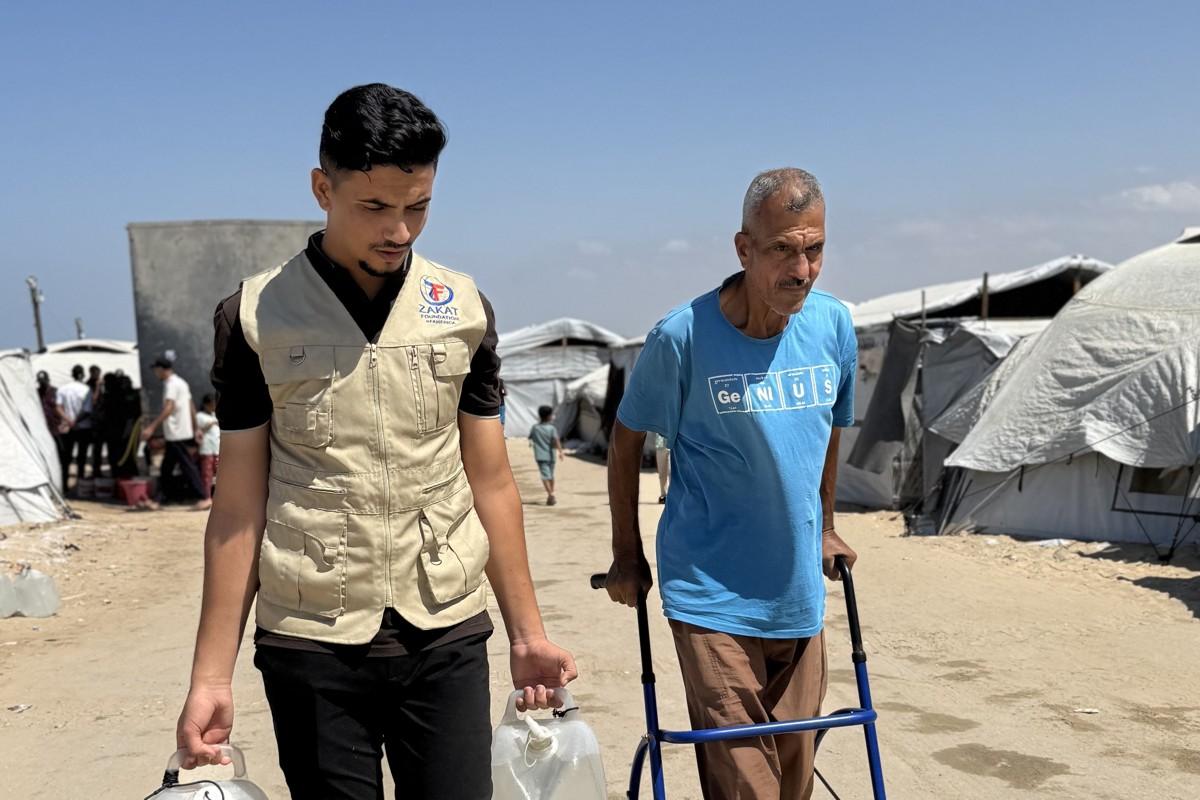
Amal on the path beside her shelter

Why Water is the Hardest Task for Displaced Families with Disabilities

Displacement means rebuilding daily life from almost nothing. Food, bedding, medicine and safety all compete for attention, and water sits underneath them. Families need it every day for drinking, cooking and washing, and it has to travel from where it is distributed to where they live.

For a household with a disability in it, distance changes everything. Alongside Amal, two more people in this story face the same daily journey for water: Huda and Samir. Huda is a widowed mother displaced from Rafah, and her household of four includes a son and a teenage daughter who both live with disabilities. The family has no wheelchair and no cart for carrying water. Huda often relies on neighbors to help her bring home water for drinking and for the household, and she does it with a herniated disc and chronic back pain.

Samir, also displaced from Rafah, lives with amputated fingers and severe visual impairment. Leaving his tent and moving around safely is difficult for him, and so is carrying anything heavy. His family has 11 members.

Water scarcity reaches far beyond Gaza, as we have reported in our coverage of the world's water emergency. In Gaza's camps, water access often comes down to one measurable thing: the distance between a family and a safe supply. Three households, three different circumstances and one shared daily question: how will the water get here?

What Changed

Zakat Foundation of America helped provide clean drinking water within the camp, at a location close to Amal's shelter. Our assessment found that this significantly reduced the physical burden of traveling long distances to collect water, and that it helped ensure the family had access to one of their most essential daily needs.

Other families have felt the same change. Huda's family now has access to clean drinking water in the camp, close to their shelter. Samir's family receives drinking water at the camp through the Drinking Water Distribution Project for Camps and Families in Need.

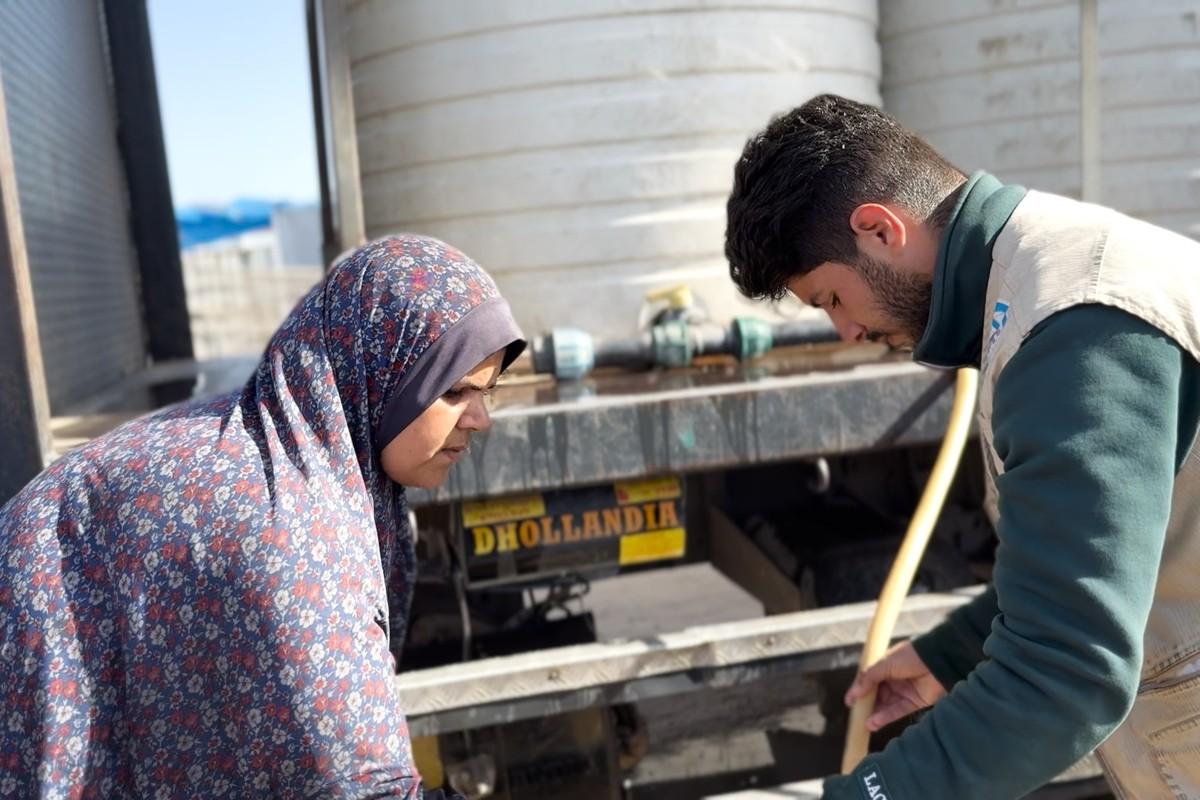
Amal with a Zakat Foundation of America team member at the Drinking Water Distribution truck

Three Years of Impact

Amal's household is one of many. Between October 2023 and September 2026, Zakat Foundation of America distributed 8,024,000 liters of clean water in Gaza. Over the same three years, our teams served 1,319,294 meals through soup kitchens and brought life-saving treatment to 11,700 patients.

By our reporting calculation of five liters per beneficiary assistance instance, that total represents 1,604,800 instances of assistance. This is a cumulative figure that includes repeated assistance, and it is not a count of unique individuals. Distribution reached displacement camps and remaining residential neighborhoods across northern, central and southern Gaza.

These figures come from our Gaza Humanitarian Impact report for October 2023 to September 2026. Behind each of them is a household making daily decisions about limited strength and limited time. The full picture of our Gaza response is in the Gaza 3-Year Impact report.

What is Still Needed

Clean drinking water is one need among many for these families, and each of them still carries a longer list. Amal’s family needs mobility aids for the family members with disabilities, food assistance and basic necessities, medical care and rehabilitation, and livelihood support. Huda’s children need wheelchairs, and her family needs a cart to carry water, along with blankets and bedding. Samir needs continuous healthcare, medications and help with his daily needs.

The things on these lists are ordinary ones: water within reach, food, a wheelchair, a blanket. Meeting them gives a family the chance to get through a day with dignity. Through our emergency relief in Gaza, you can help provide clean drinking water, food and hygiene supplies to families like Amal’s, Huda’s and Samir’s.

Help Families Through the Winter

Families living with disability and displacement face the cold season with very little. Your gift to our winter relief can bring warmth and essential support to families in need.

Published: November 13, 2026